SCMA-1 FM SCA MODULATION MONITOR
Description
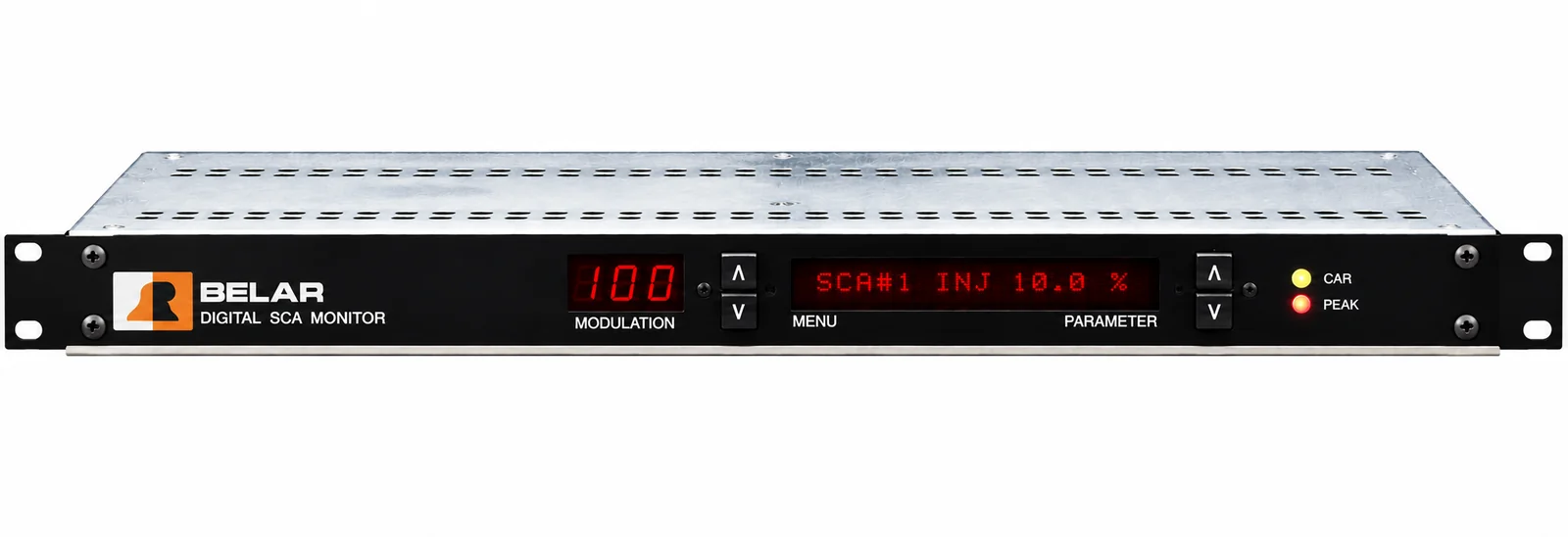
The Belar SCMA-1 Digital FM SCA Modulation Monitor and Analyzer is a DSP based precision SCA monitor designed to operate in conjunction with the Belar FMMA-1 or FMM-2 Modulation Monitor or other source of wideband composite.
The SCMA-1 digitizes the composite and decodes the selected subcarrier signal using digital signal processing techniques. Unlike an analog design, a DSP based design is not subject to variations due to temperature, component aging, or component tolerances. The resulting circuit requires no adjustments, but can achieve extremely tight tolerances. In addition, the DSP design allows the use of FIR linear phase filters whose bandwidth can be varied via the front panel. The use of variable bandwidth filters allow the user to optimize the subcarrier BPF and detector LPF cutoff frequencies for a particular SCA modulation scheme. The use of DSP processing also eliminates the need for separate crystal oscillators for each subcarrier frequency, instead all available frequencies are synthesized from a common system clock.
The SCMA-1 implements all its metering and measurement functions using DSP processing. Therefore, the SCMA-1's calibration does not depend on any adjustable circuit components or their tolerances. This guarantees the calibration of the unit will remain stable over time. By digitizing the measurements the user can display modulation peaks, injections, and dB readings directly. As an added benefit, all readings can be viewed remotely using an IBM compatible personal computer.
Features
- Total Modualtion 0 to 150%
- Variable Bandwidth Digital IF Filtering with HD Carrier Suppression
- SCA Frequncy Range 41.0 to 100.0 kHz
- Variable BW SCA BPF Filtering 1 to 16 kHz
- Variable BW SCA Detector Filtering 1 to 8 kHz
- SCA Deviation Normalization 100% 1.0 to 7.0 kHz
Specifications
Metering
- Total, Main (L+R), Subcarrier Modulation
- 0-150%, 1% increments, peak reading
- Main (L+R), Subcarrier Modulation
- +3.5 to -99 dB, 0.5 dB steps, autoranged RMS reading
- Subcarrier Injection
- 0.0-25.5%, 0.1% increments
Subcarrier
- Frequency Range
- 41.0-100.0 kHz, 0.5 kHz steps
- BPF Bandwidth
- 1-16 kHz, 1 kHz steps
- Detector Bandwidth
- 1-8 kHz, 1 kHz steps
- Deviation Sensitivities
- 100% = 1.0-7.0 kHz, 0.1 kHz steps
- Internal Calibrator
- 67 kHz, 6 kHz dev, 1 kHz mod @ 10.0%
Input
- Composite
- 1.0 - 2.0 Vrms (2.8V - 5.7V P-P), 100 kΩ, unbalanced, BNC Connector
Outputs
- Main (L+R) Audio
- +10 dBm, 600 Ω, balanced, XLR connector
- Main (L+R) Test
- 5 Vrms, 75 Ω, unbalanced, BNC connector
- Scope
- 2.5 Vrms auto-ranged, 75 Ω, unbalanced, BNC connector
- Subcarrier Audio
- +10 dBm, 600 Ω, balanced, XLR connector
- Subcarrier Test
- 5 Vrms, 75 Ω, unbalanced, BNC connector
- Subcarrier BPF
- 0.1414 Vrms @ 10.0%, 75 Ω, unbalanced, BNC connector
Interface
- Serial
- RS-232
- Unit
- Wizard Standard Interface
Remote Meter Outputs
Subcarrier Analog Modulation Meter
Open collector and relay closures for subcarrier presence
and subcarrier peak modulation indicators.
Main (L+R) Specifications
20 Hz to 15 kHz
- Frequency Response
- ±0.1 dB
- Distortion (THD + Noise)
- 0.01%
- SNR
- 80 dB
Subcarrier Specifications
BPF BW = 16 kHz, Detector BW = 8 kHz
- Frequency Response — BPF In
- +0.1, -1.75 dB
- Frequency Response — BPF Out
- ±0.1 dB
- Distortion (THD + N) — BPF In
- 0.25%
- Distortion (THD + N) — BPF Out
- 0.05%
- SNR, 150 µsec de-emphasized
- 80 dB
Frequency response measured from 20 Hz to 8 kHz at 6 kHz deviation. Distortion measured at 1 kHz, 6 kHz deviation.
Crosstalk
- Sub to Main
- 80 dB
- Main to Sub
- 80 dB
- Stereo to Sub
- 80 dB
Packaging
- Dimensions
- 1.75" H × 14.5" D × 19" W, 1 EIA Rack Unit
- Power Requirements
- 17 Watts, 100-240 VAC, 50-60 Hz
- Net Weight
- 7 lbs.
- Shipping Weight
- 11 lbs.
Specifications are subject to change without prior notice.
Downloads
Operator Manual
Complete operating instructions, setup information, controls, connections, and technical information for the SCMA-1.
View Manual →Software & Updates
Download current SCMA-1 software and review available updates.
Software Updates →